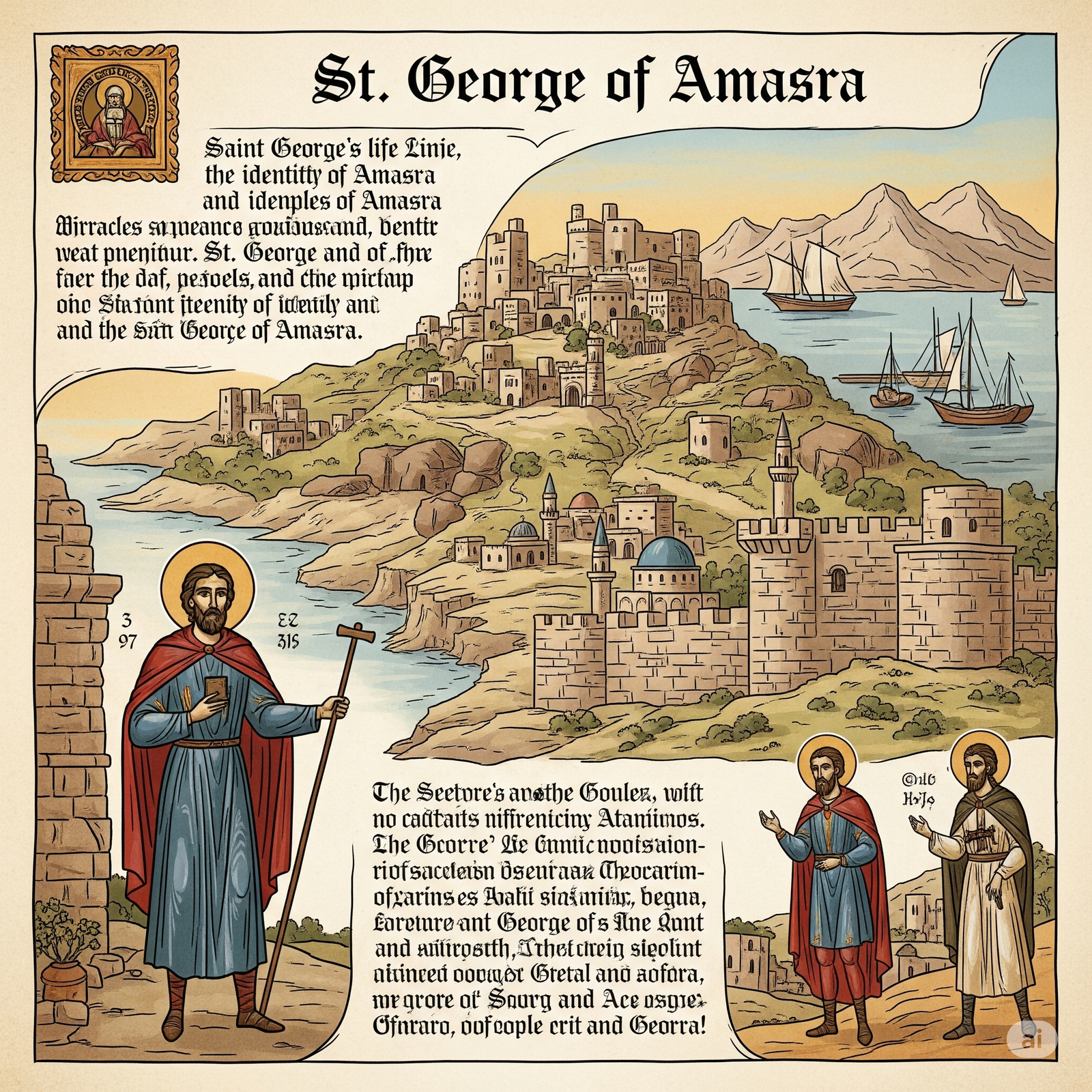
Introduction: The Sacred Heritage of Amasra and St. Georgios
Karadeniz’in incisi olarak bilinen Amasra, köklü tarihi ve doğal güzellikleriyle öne çıkan bir şehirdir. Bu zengin mirasın önemli bir parçası da Bizans dönemine ait kutsal figürler ve onların hikayeleridir. Bu kapsamlı incelemede, Amasra’nın koruyucu azizlerinden biri olan Amasra’lı Aziz Georgios’u detaylı bir şekilde ele alarak, onun hayatını, mucizelerini ve Amasra’nın tarihsel dokusuyla olan derin bağını keşfedilecektir. Tarihsel anlatıya başlamadan önce, Hristiyan dünyasında “Ejderha Katili” olarak bilinen ve 23 Nisan’da anılan Büyük Şehit Aziz Georgios ile Amasra’lı Aziz Georgios’un farklı kişiler olduğunu belirtmek büyük önem taşımaktadır.1 St. Georgios the Great Martyr was a soldier from Cappadocia who was martyred under the Roman Emperor Diocletian (303). His life is full of miracles and resilience in the face of persecution, such as his marching in iron boats, surviving a well of boiling lime and smashing idols.1 St. Georgios of Amasra was a bishop and ascetic of the late 8th and early 9th centuries; he was a spiritual leader, not a military martyr. This distinction is critical for a proper understanding of the issue and to avoid common misunderstandings. Clearly distinguishing between these two different saints is a vital step in emphasizing the unique historical context of St. Georgios of Amasra and helps to clear up any confusion in the reader's mind.Amasra (Amastris) in the Byzantine Period: A Port and Religious Center
Amasra, known as Amastris in ancient times, was a strategically and economically important city on the Black Sea coast during the Byzantine Empire.2 The city made its first appearance in Byzantine history in 695, when a local monk, Kyros, predicted that Emperor Justinian II would regain the throne.2 Especially since the 9th century, Amasra has been one of the main ports of maritime communication in the Black Sea and an important military base.2 In the 10th century, Niketas David Paphlagon referred to Amasra as the "eye" of Paphlagonia and the "Emporion" (trade center) of the trade with the Scythians (Russians) in the north, which clearly shows the prosperity and commercial vitality of Amasra in this period.3 Bu tanımlamalar, şehrin bölgesel ve uluslararası ticaretteki merkezi rolünü vurgulamaktadır. Amasra, Bizans döneminde sadece ticari ve askeri değil, aynı zamanda dini açıdan da önemli bir merkezdi. Başlangıçta Gangra’ya bağlı bir piskoposluk iken, 940 yılına gelindiğinde metropolitlik seviyesine yükseltilmiştir.3 This rise in religious status reinforced the city's growing importance and religious authority. Administratively, in the 10th century it was a city of the theca of Paphlagonia and the seat of a calepanon (local governor); in the 12th century it was ruled by a doux (military governor).3 Bu idari ve dini yükseliş, Amasra’nın Bizans İmparatorluğu içindeki çok yönlü önemini ortaya koymaktadır. Şehrin Bizans dönemindeki varlığı, özellikle dış saldırılara karşı geliştirilen tahkimatlarla karakterize edilmiştir. 9. yüzyılda Rusların Karadeniz sahillerine düzenlediği akınlar sonrasında, Amasra Kalesi’nin savunmasını güçlendirmek amacıyla yeni sur duvarları inşa edilmiştir.4 It was determined that smaller stones and thicker mortar were used in the walls built during this period compared to the Early Byzantine period, and brick material was also introduced.4 The part of the ancient city that spread to the mainland was probably abandoned after the Russian attack, and Amasra was reconstructed within new walls, with its two harbors on the neck and steep slopes of the peninsula.3 This urban transformation is a concrete example of Amasra's adaptation and resilience to external threats by reshaping not only its military but also its urban structures. While this emphasizes the city's survival strategies and the importance of its strategic location, it also reveals the physical infrastructural equivalent of the protective role mentioned in St. Georgios' Vita. This shrinking of the city and the strengthening of its fortifications clearly shows how Byzantine cities developed a defensive psychology and practices during difficult times.The Life and Miracles of St. Georgios of Amasra
St. Georgios of Amasra was born in the mid-8th century in Kromna (modern Kurucaşile), about 40 km east of Amasra.6 At a young age he began a career in church administration, but later abandoned this path and retreated to an ascetic life as a hermit on Mount Agrioserike near Amasra.6 His miracles and fame on this mountain brought great pride and joy to the people of Amasra, for they considered him their "homemade hero".6 St. Georgios later joined a monastic community called Bonyssa and continued his spiritual development.6 When the office of bishop of Amasra became vacant in about 790, Patriarch Tarasios of Constantinople appointed Georgios, despite the emperor's preference for someone else.6 Georgios was consecrated as a bishop in Constantinople. During his tenure, the diocese of Amasra was elevated to autocephalous (independent) status.6 St. Georgios fulfilled not only his spiritual duties as a bishop, but also his social responsibilities. He healed the sick, reformed sinners, enriched the poor and eliminated debts. It is said that during his reign there was general prosperity in the city.6 Bu anlatılar, Aziz Georgios’un sadece dini bir lider olarak değil, aynı zamanda halkının maddi ve manevi refahına katkıda bulunan bir figür olarak kabul edildiğini göstermektedir. Aziz Georgios’un hayatı, özellikle Amasra’yı dış tehditlerden koruyan ve halkına umut veren mucizelerle doludur. En dikkat çekici mucizelerden biri, daha önce bilinmeyen Rusların Amasra’ya düzenlediği saldırıdır. Aziz Georgios’un hagiografisi (“Vita”), Rusları “barbarlıkları, vahşetleri ve zulümleriyle herkesçe bilinen bir halk” olarak tanımlar.7 According to the text, the Russians wanted to loot the Saint's tomb, but the city was saved by the Saint's divine intervention.7 This event is considered by many historians to be the earliest written record of the Russians' migration to Southeastern Europe and their first known contacts with the Byzantine Empire.10 This event demonstrates that Amasra was not only the center of a local religious figure, but also an important geopolitical theater of events in the early period of Byzantine-Russian relations. This emphasizes Amasra's strategic position on the Black Sea and its dynamic relationship with Byzantium's northern neighbors, placing a local hagiographic narrative in a broader historical context. Scholarly debate continues over the date of this attack; some place it between 825-830, others link it to the raid on Constantinople in 860, while others point to the 830s.7 Vita mentions the existence of a "closed fortification system" in Amasra during this attack 5, şehrin savunma yapısının önemini de göstermektedir. Vita’ya göre, Aziz Georgios’un koruyucu etkisi sadece Rus saldırısıyla sınırlı kalmamıştır. Bölgeyi hedef alan bir Arap istilası sırasında, Aziz’in köyleri dolaşarak sakinleri yaklaşan tehlikeye karşı uyardığı ve onları şehrin sağlam surlarının arkasına yönlendirdiği anlatılır.6 Even after his death, the Saint is said to have continued to perform miracles from his shrine, for example preventing the Amasra River from overflowing and protecting the surrounding countryside from severe floods.6 The depiction of St. Georgios as not only a spiritual leader but also a physical protector of his city and its rural hinterland reinforced the perception of him as a "homemade hero" for the people of Amasra. This is a powerful theme that illustrates how hagiography shapes local identity and civic pride, and cemented the Saint's place in Amasra's cultural memory. His multifaceted role as protector emphasizes his importance in the daily life and defense of his people.Table 1: Important dates and events in the life of St. Georgios of Amasra
| Date Range | Event | Source | Additional Explanation |
| ~mid 8th century | Birth | 6 | He was born in Kromna (modern Kurucaşile), about 40 km east of Amasra. |
| ~late 8th century | The beginning of a career in church administration and his retreat to a life of asceticism | 6 | He lived an ascetic life on Mount Agrioserike near Amasra and later joined the Bonyssa Monastery. |
| ~790 | His appointment as Bishop of Amasra | 6 | He was appointed by Patriarch Tarasios of Constantinople, despite the emperor's preference. |
| During his tenure | Elevation of the Diocese of Amasra to autocephalous status | 6 | It shows the growing religious importance of the city. |
| ~802/807 | Deceased | 7 | He died early in the reign of Emperor Nikephoros I. |
| 9th century | Russian attack (dating disputed) | 5 | It is told that Amasra was saved by the miraculous intervention of the Saint. It is considered one of the first Russian contacts with Byzantium. |
| Term of office and beyond | Miracles such as protection against Arab attacks and flood control | 6 | He led the people behind the walls and prevented the river from overflowing after death. |
| 10th century | The survival of the "Life of St. Georgios" (Vita) manuscript | 6 | The only primary source on the life and miracles of the Saint. |
| February 21 | Memorial Day of St. Georgios | 6 | The day he was canonized as a saint in the Orthodox Church. |
"The Life of St. Georgios" (Vita): Significance as a Historical Source
The life and miracles of St. Georgios of Amasra are described in the hagiographic text "The Life of St. Georgios" (Vita), which survives in a single manuscript from the 10th century (Paris, Bibliothèque nationale de France, gr. 1452, fols. 57r-75r).6 This text is a unique primary source for Byzantine studies, providing a "gold mine" of information about Byzantine provincial life.6 Metnin 19 folio boyunca Aziz’in hayatını ve mucizelerini detaylandırması, dönemin sosyo-kültürel yapısına dair zengin bir pencere açmaktadır. Vita, Ortaçağ Karadeniz limanının işleyişi, taşra şehri ile kırsal hinterland arasındaki ilişki, sıkıntı zamanlarında savunma ve dayanıklılık psikolojisi, sivil gurur ve yerel kimlik gibi konularda nadir bilgiler sağlar.6 The text has a standard hagiographical structure, including the Saint's origins, upbringing, spiritual formation, his mature achievements and posthumous miracles.6 This structure reflects the hagiographic traditions of the period, while at the same time ensuring the coherence of the narrative. In particular, Saint's expectation to serve the people of Amasra and its environs, rather than being limited to caring for his own family, demonstrates the prevalence of the idea of settlement-based, local loyalty in Byzantine hagiography.6 The original authorship and dating of the work remain unclear. Most scholars agree that the text was written in the 9th or 10th century.6 Some scholars, such as Vasily Vasilievsky and Ihor Ševčenko, attribute the work to the Saint's contemporary Ignatios Deacon and date it before 842, while Germaine da Costa-Louillet and Wanda Wolska-Conus offer different opinions.7 Athanasios Markopoulos, on the other hand, argued that most of the work belonged to Ignatios, but that the section on the Russian attack was added later (between 858-886) under the influence of Patriarch Photios.7 Alexander Kazhdan, on the other hand, has argued that despite the text's close ties to Empress Irene and Nikephoros I, its lack of anti-iconoclast rhetoric and similarities to Emperor Nikephoros II Phokas (963-969) suggest that it can be dated to the late 10th century.7 The ongoing scholarly debate over the authorship and dating of the Vita demonstrates that hagiographical texts are not only religious narratives, but also valuable sources of information about Byzantine history, culture, and politics that require careful interpretation. These debates reveal the difficulties historians face and the methodological rigor they apply when extracting information from primary sources. In this way, the Vita offers a unique window into Byzantine provincial life.Traces of St. Georgios and Locations in Amasra
Although there is no specific church or monastery directly dedicated to St. Georgios in Amasra that has survived to the present day 13There are important Byzantine buildings and ruins that bear witness to his time and influence. Fatih Mosque (Former Byzantine Church): The Fatih Mosque, located inside Amasra Castle, was originally a Byzantine church built in the 9th century.4 It was converted into a mosque during the conquest of Amasra by Fatih Sultan Mehmet in 1460/1461.20 Although the original name of this church is not known for certain, it is referred to as "Old Church" or "Amasra Church" in the sources.22 The 9th century date of the building is of great significance as it coincides with the episcopate of St. Georgios (ordained c. 790) or shortly after his death. It is an architectural witness to the period in which the Saint lived and served, and is one of the most tangible Byzantine heritages in Amasra. The fact that the Fatih Mosque was built as a Byzantine church in the 9th century provides the most tangible and present-day structural link to the period in which St. Georgios lived in Amasra. This is a critical point for visitors to connect the Saint's story to the physical fabric of the city and experience history in a more tangible way.


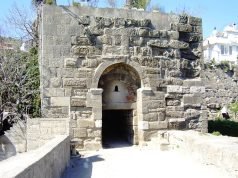
 Amasra Castle and Walls: The existence of a "closed system of fortifications" in Amasra during the Russian attack, mentioned in the Vita of St. Georgios 5emphasizes the importance of the city's defense structure. Amasra Castle and the walls surrounding it are an indication of the military and strategic importance of the city during the Byzantine period. Aziz's directing the people behind the walls during the Arab attacks 6 these fortifications played an active role and were central to the defense of the city. The ruins of the castle standing today bear witness to these historical events and symbolize the city's resilience in the past.
Mount Agrioserike and Bonyssa Monastery: It is stated that Mount Agrioserike, where St. Georgios practiced asceticism, is near Amasra and the Bonyssa Monastery, which he later joined, is also located in the region.6 Although the precise locations of these locations cannot be pinpointed today, it suggests that the rural hinterland of Amasra played an important role in the Saint's spiritual journey and was not just the urban core of the city. This emphasizes the Saint's connection to the local environment.
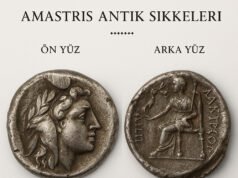
Amasra Museum: Amasra Museum is home to various archaeological finds from the Byzantine period. Cross necklaces, oil lamps, ceramics and coins on display here 6The Vita provides valuable clues to the daily life and religious practices of St. Georgios' time. These artifacts provide valuable insights into the "provincial Byzantine life" described in the Vita. 6 and provide visitors with a visual and tactile context of the society in which the Saint served. The Byzantine artifacts in the Amasra Museum embody the socio-cultural environment in which St. Georgios lived, serving as a bridge to understand not only historical events, but also the beliefs, lifestyles and economic activities of the people of that period.
Amasra Castle and Walls: The existence of a "closed system of fortifications" in Amasra during the Russian attack, mentioned in the Vita of St. Georgios 5emphasizes the importance of the city's defense structure. Amasra Castle and the walls surrounding it are an indication of the military and strategic importance of the city during the Byzantine period. Aziz's directing the people behind the walls during the Arab attacks 6 these fortifications played an active role and were central to the defense of the city. The ruins of the castle standing today bear witness to these historical events and symbolize the city's resilience in the past.
Mount Agrioserike and Bonyssa Monastery: It is stated that Mount Agrioserike, where St. Georgios practiced asceticism, is near Amasra and the Bonyssa Monastery, which he later joined, is also located in the region.6 Although the precise locations of these locations cannot be pinpointed today, it suggests that the rural hinterland of Amasra played an important role in the Saint's spiritual journey and was not just the urban core of the city. This emphasizes the Saint's connection to the local environment.
Amasra Museum: Amasra Museum is home to various archaeological finds from the Byzantine period. Cross necklaces, oil lamps, ceramics and coins on display here 6The Vita provides valuable clues to the daily life and religious practices of St. Georgios' time. These artifacts provide valuable insights into the "provincial Byzantine life" described in the Vita. 6 and provide visitors with a visual and tactile context of the society in which the Saint served. The Byzantine artifacts in the Amasra Museum embody the socio-cultural environment in which St. Georgios lived, serving as a bridge to understand not only historical events, but also the beliefs, lifestyles and economic activities of the people of that period.
Table 2: Historical Locations Associated with St. Georgios in Amasra
| Location Name | The Connection with St. Georgios | Current Status/Importance | Source |
| Fatih Mosque | It was built as a Byzantine church in the 9th century, coinciding with the episcopate of St. Georgios. | Today it is used as a mosque and is located in Amasra Castle. It is one of the most tangible Byzantine heritages in Amasra. | 4 |
| Amasra Castle and Walls | The Vita of St. Georgios indicates the existence of a "closed fortification system" during the Russian attack. The Saint is said to have led the people behind the walls during the Arab attacks. | The remains of the Byzantine city walls can still be seen today, symbolizing the strategic importance and resilience of the city. | 4 |
| Agrioserike Mountain | It is the place where St. Georgios practiced asceticism and lived as a hermit. | Although its exact location is not known today, it is stated to be in the rural surroundings of Amasra. | 6 |
| Bonyssa Monastery | The monastic community that St. Georgios joined as part of his ascetic life. | Its exact location is not known today. | 6 |
| Amasra Museum | Byzantine artifacts (cross necklaces, oil lamps, ceramics, coins) from the period when St. Georgios lived are exhibited. | It provides visitors with concrete information about the daily life and material culture of Byzantine Amasra. | 6 |
St. Georgios' Legacy and Memorial Day
St. Georgios of Amasra is recognized as a saint in the Orthodox Church and his memorial day is February 21.6 More than just a religious narrative, his life and miracles are an integral part of Amasra's historical identity and cultural heritage. He has become a symbol of the city's resilience in difficult times and the pride of the local population in their "home-made hero".6 St. Georgios will continue to be remembered as the patron saint of the city, representing Amasra's vibrant connection to the past. His story shows that Amasra is not only united by its natural beauty, but also by its deep historical and spiritual heritage.Conclusion: St. Georgios in the Historical Depth of Amasra
Amasra’lı Aziz Georgios’un hikayesi, sadece bir azizin biyografisi değil, aynı zamanda Bizans İmparatorluğu’nun Karadeniz’deki önemli bir liman kentinin, Amasra’nın, stratejik önemini, dini yaşamını, dış tehditlere karşı mücadelesini ve kültürel kimliğini yansıtan zengin bir anlatıdır. Onun Vita’sı, akademik tartışmalara rağmen, dönemin taşra yaşamına dair eşsiz bilgiler sunan birincil bir kaynak olmaya devam etmektedir. Bu metin, Bizans İmparatorluğu’nun uzak bir köşesindeki yaşamın karmaşıklığını ve zenginliğini anlamak için vazgeçilmez bir kaynaktır. Amasra’yı ziyaret edenler, Fatih Camii’nin duvarlarında, kale surlarında ve Amasra Müzesi’nin sergilerinde Aziz Georgios’un ruhunu ve onunla birlikte Bizans Amasra’sının derin izlerini bulabilirler. Bu konumlar, Aziz’in yaşadığı dönemin somut kanıtları olarak, ziyaretçilere geçmişle canlı bir bağ kurma fırsatı sunar. Aziz Georgios, Amasra’nın geçmişle olan canlı bağını temsil eden, şehrin koruyucu azizi olarak anılmaya devam edecektir. Onun mirası, Amasra’nın sadece doğal güzellikleriyle değil, aynı zamanda zengin tarihsel ve kültürel dokusuyla da bir bütün olduğunu vurgulamaktadır.Author: Kemal Onur Özman
Original PDF version of the article and sources: History of St. Georgios of Amasra_